







 Russian
 English
 Spanish
 German
 Italian
 French
 Portuguese


In the world of precision demolition and rock excavation, a drum cutter is one of the most powerful investments you can make for your fleet. However, for procurement managers and project leads, the challenge isn’t just buying a “grinding head”—it’s ensuring the attachment is perfectly synchronized with the carrier.
A mismatch in hydraulic parameters or tonnage can lead to sluggish performance, excessive fuel consumption, or even catastrophic damage to your excavator’s hydraulic motor.
In this guide, we break down the critical factors for choosing between transverse and axial drum cutters and how to match them to your 20t–50t excavators.
Transverse vs. Axial: Which Design Suits Your Project?
Before looking at the specs, you must decide on the orientation of the cutting heads.
Transverse Drum Cutters (Horizontal)
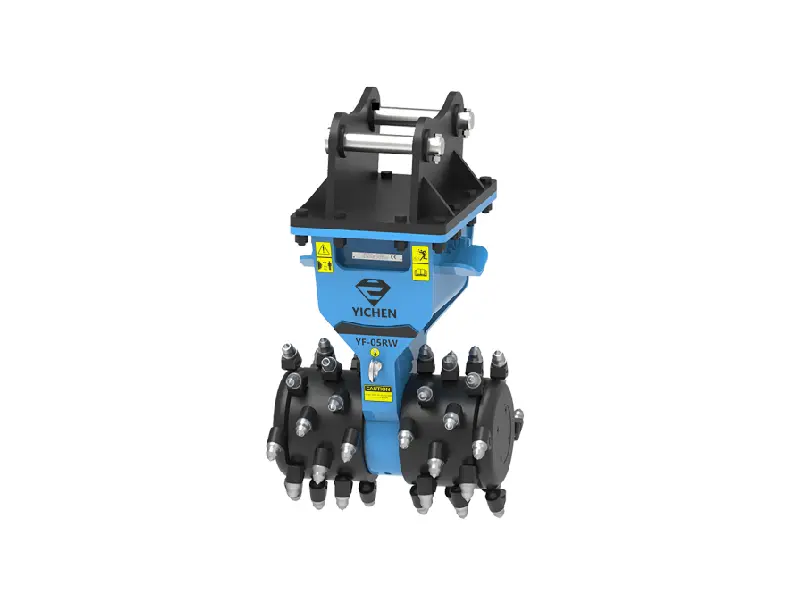
YF-20RW Drum Cutter for excavator 15-20ton
The most common configuration, featuring two drums mounted horizontally.
- Best for: Bulk excavation, trenching, demolition of concrete buildings, and quarrying.
- The Advantage: They offer higher stability and are designed to “eat” through large surface areas efficiently. If your goal is high-volume material removal, the transverse model is your workhorse.
Axial Drum Cutters (Longitudinal/Vertical)

YD-20RD Drum cutter for excavator 18-30ton
A single drum mounted in line with the excavator’s arm.
- Best for: Narrow trenching, cleaning pile heads, precision profiling in tunnels, and working in corners.
- The Advantage: They allow for surgical precision. If you need to grind a circular shaft or reach into a tight 90-degree corner where a horizontal drum cannot fit, the axial cutter is the solution.
The Golden Rule of Hydraulic Matching
For a drum cutter, hydraulic power is the lifeblood. If the excavator cannot provide the required flow and pressure, the drum will stall the moment it touches the rock.
Oil Flow (L/min) vs. Cutting Speed
The flow rate determines the RPM (Rotation Per Minute) of the drum.
- Too Low: The drum rotates too slowly, causing the picks to “bounce” off the rock instead of cutting it, leading to extreme vibration.
- The Match: Ensure your excavator’s auxiliary line can provide at least 90% of the drum cutter’s rated maximum flow.
Operating Pressure (Bar) vs. Torque
Pressure determines the Torque (Twisting Power).
- The Risk: If your excavator’s relief valve is set too low, the cutter won’t have the “bite” to break hard rock (e.g., granite or reinforced concrete).
- Pro Tip: Always check if your excavator requires a dedicated “return line” to the tank to prevent backpressure from blowing out the motor seals.
Selecting by Excavator Tonnage: 20t to 50t

Matching the weight of the cutter to the carrier is vital for the center of gravity and the longevity of the excavator’s pins and bushings.
| Excavator Class | Typical Project | Recommended Cutter Weight | Key Parameter |
| 18t – 25t (e.g., CAT 320) | Urban utility, trenching | 800kg – 1,200kg | Focus on agility and cooling. |
| 26t – 35t (e.g., Komatsu PC300) | Road construction, tunnels | 1,400kg – 2,200kg | High torque for medium-hard rock. |
| 36t – 55t | Mining, large-scale dredging | 2,500kg – 4,000kg | Maximum flow capacity is critical. |
Avoiding the “Power Trap”: Common Procurement Mistakes
- Ignoring the Rock Hardness (UCS): Not all drum cutters are rated for hard rock. If you are cutting material with a Unconfined Compressive Strength (UCS) above 80MPa, you need a heavy-duty motor and specialized “picks” (teeth).
- Skipping the Case Drain Line: Most high-performance drum cutters require a third hydraulic line (case drain) to protect the motor. Installing without this can destroy the attachment within hours.
- Underestimating Heat: Grinding generates heat. Ensure your excavator’s cooling system is in top shape, especially for continuous work in tunneling.
Why Choose YC Attachments?
At Вложения YC, we don’t just sell equipment; we provide engineered solutions. Our drum cutters are built with high-torque hydraulic motors and wear-resistant alloy drums designed to withstand the harshest environments. Whether you are running a 20-ton nimble excavator or a 50-ton heavy lifter, we provide the technical data sheets to ensure a “plug-and-play” fit.
Ready to Optimize Your Excavator?
Choosing the right attachment is a balance of science and experience. Don’t leave your ROI to chance.
[Click here to learn more about Yichen Drum Cutter Specification] or contact our engineering team today for a free hydraulic compatibility analysis for your specific excavator model.


